Britain’s push towards net zero by 2050 is driving a new frontier in renewable energy: floating offshore windfarms, but concerns about attachment risks persist
By Edwin Lampert
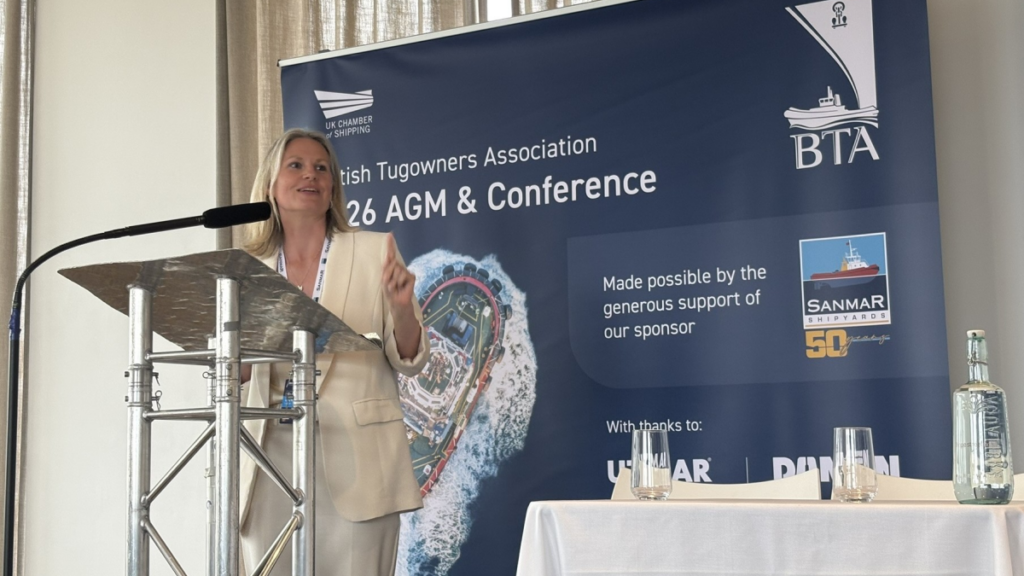
Lisa Tuckwell (SOSREP): “Consider these new risks and develop appropriate response plans” (source: SOSREP)
At this year’s British Tugowners Annual Conference in Liverpool, a pointed question cut through the optimism: what happens if floating offshore windfarms break free?
Pilot projects off the northeast coast of Scotland have been in place since 2018. Until recently, however, they were largely absent from the emergency response planning of the authorities responsible for intervention if something goes wrong. That this gap is being highlighted by Lisa Tuckwell, deputy to the Secretary of State’s Representative for Maritime Salvage and Intervention (SOSREP), makes it notable. Highlighting that she was originally told a drifting turbine “would never happen”, she has encouraged cross government and commercial workshops to consider these new risks and develop appropriate response plans.
The UK is at an inflection point. Fixed offshore wind is already widespread; floating wind is next, and its expansion is a matter of timing, not possibility. These structures are being proposed to operate farther offshore, in deeper water, and rely on mooring systems unlike anything the towage and salvage sectors have handled at scale.
At the centre is a basic definitional problem. When under tow, a floating turbine is increasingly treated as a vessel. Once on station, generating power, that clarity disappears. Is it a vessel, a platform or an installation? The answer determines jurisdiction, applicable law, and whether agencies like SOSREP can intervene if a unit begins to drift. As Ms Tuckwell put it, without a settled definition, assigning responsibility is extremely difficult.
This uncertainty has practical consequences. Commercial vessels are increasingly required to carry emergency towing connections so salvage tugs can act quickly and safely. As yet, floating turbines do not. Their design further complicates intervention: spar-buoy structures must be towed base-first, with the upper assembly installed separately, turning emergency response into a pre-engineered operation. Semi-submersible and barge designs offer more flexibility, but none were designed with unplanned salvage in mind. As Ms Tuckwell noted, you cannot simply secure a line to a 200-metre-tall structure and hope it holds.
Scale intensifies the problem. Scotland’s planned floating wind developments alone could involve more than 1,400 turbines, many 150–200 metres tall, with some approaching 300 metres. These are not static assets. They are periodically towed to port for maintenance under controlled conditions. That is manageable. Less so is the scenario in which weather or mechanical failure causes multiple units to break free at once, in congested waters and in conditions that demand rapid, improvised response from limited towage capacity.
The UK is not alone. Norway and Finland have already begun addressing emergency response for floating wind. In the UK, workshops led by the Maritime and Coastguard Agency and Deputy to the SOSREP, involving licencing authorities, government departments and the general lighthouse authorities, have established awareness, but not yet solutions to emergency towage. Dedicated engagement with the towage industry to map real capability and limitations is now planned.
The window to influence turbine design is limited. Industry participants suggest that meaningful changes, such as mandated emergency towing points, defined attachment geometry and minimum operating conditions, remain feasible until around 2030. Ms Tuckwell hopes to continue working collaboratively with the renewable and towage industry and government departments to address this issue, to ensure the safety of those responding to emergencies involving floating offshore wind turbines.
The article can be found on Riviera’s website here – Riviera – News Content Hub – Adrift without a framework: floating offshore wind and the emergency response gap
With gratitude to Edwin Lampert and Riviera for granting permission to the BTA to publish the article.